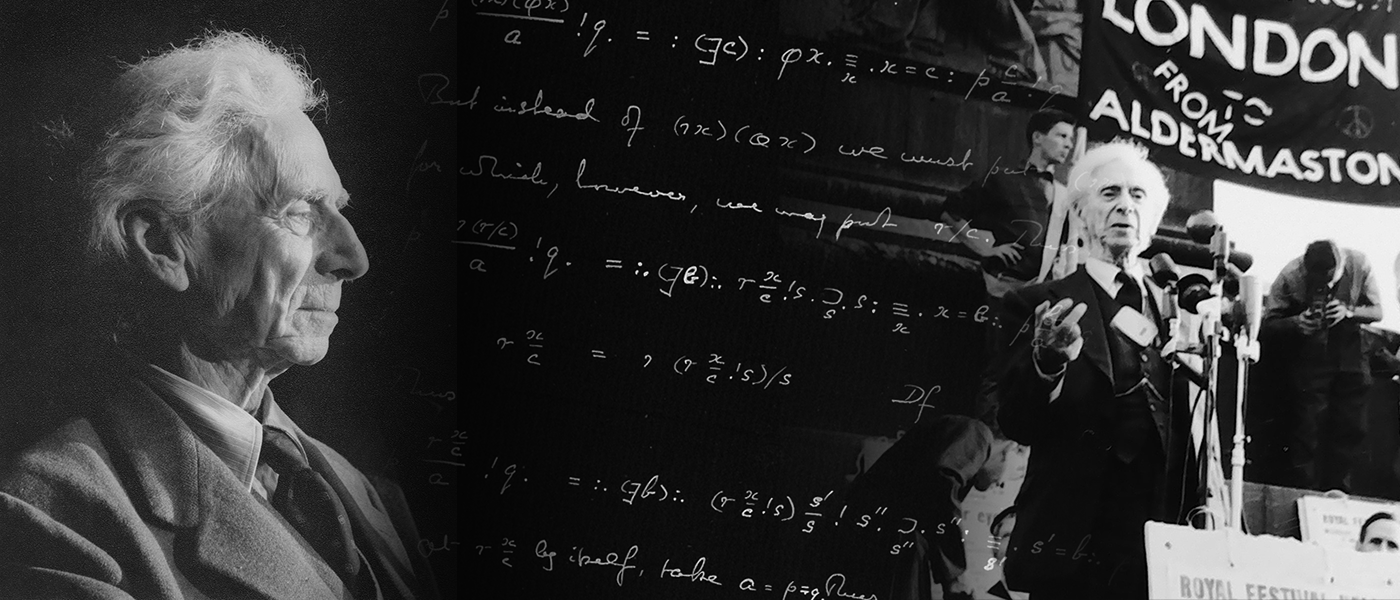
Bertrand Russell: A Hypertextual Draft Edition of a
Paper from Volume 24
able of Contents
Annotation
Textual Notes
Bibliographical Index
"The Bomb and Civilization"
(1945)
nnotation to Paper 58
- Atoms
In The ABC of Atoms (1923a),
pp. 9-10, Russell writes in much the same detail and with the same
figures
about the minuteness of atoms. He also predicted, of nuclear
research, that "It is probable that it will
ultimately be used
for making more deadly explosives and projectiles than any yet
invented" (1923a, 11; quoted by
Wood 1957,
152).
- Rutherford
Ernest Rutherford
(1871-1937), New Zealand-born British physicist. He was Professor
of Physics at
McGill University in Montreal from 1898 to 1907, when he left for
Manchester. In 1919 he became director
of
the
Cavendish Laboratory in Cambridge. He won the Nobel Prize for
chemistry in 1908.
- more powerful process O.R. Frisch and
Lise Meitner concluded
that the results of experiments done by the German
chemist, Otto Hahn, in December 1938 could only have been obtained
as the result of nuclear fission. Frisch
verified
their assumption with experiments done in Copenhagen in January
1939.
- the
Germans on the one side, and the British and Americans
German research was led by
Werner Heisenberg. The
British and Americans at first worked separately but during the
Quebec Conference of August 1943 agreed to
work together.
- foreseen for over forty
years Wittner 1993
discusses H.G. Wells' The World Set Free (1914), which
portrays a war fought with nuclear
weapons.
- Bohr
Niels Bohr (1885-1962), Danish physicist, worked with Rutherford at
Manchester before returning to
Denmark.
He spent World War II in the United States.
- Heisenberg
Werner Karl Heisenberg
(1901-1976), German physicist. With Max Born, he worked in quantum
mechanics, proposing the uncertainty principle in the 1920s. He won
the Nobel Prize for physics in
1932.
- Schrödinger<
/A> Erwin
Schrödinger (1887-1961), Austrian physicist. He won the Nobel
Prize for physics in 1933 and left
Germany for Oxford that same year. He spent World War II in
Dublin.
- by surrender or
extermination. Emperor Hirohito decided to surrender
on 10 August 1945, but the
Japanese military
did not agree until 14 August. See Weintraub 1995, Chap. 33.
- a month
ago This was a reasonable belief at the time, since
contested. In early July 1945 Russia had
as yet no Far
Eastern military presence to speak of but was very strong in
Eastern Europe, Austria and East Germany. The
United
States was rapidly defeating the Japanese forces except on the home
islands but was redirecting its troops
from Europe
to the planned invasion of Japan. Both had reached a peak of
conventional weapons production. Thus in all
factors
considered together, they might have seemed equal in "warlike
strength" before the explosion of America's
plutonium
test bomb on 16 July 1945. Yet the distribution of that strength
was very unequal, with the Russians being
overwhelmingly strong in Europe, and America's atomic arsenal was
unknown to the public and, indeed, the
other powers.
- make these bombs for themselves With
the failure of the Baruch
plan, the Americans set up their own Atomic
Energy Commission. The legislation creating this agency was passed
in August 1946 and came into effect in
January
1947. The Act restricted the exchange of information on atomic
energy, thus reducing American-British
cooperation.
On 8 January 1947 Attlee and other ministers authorized the
manufacture of a British atomic bomb. The first
British
atomic test was 3 October 1952. The Soviets exploded their first
atomic bomb at the end of August 1949. See
Russell
1949a,
written on that occasion.
- control of the
international authority The Atomic Development
Authority {See Papers
84, C47.12, and 87, C48.02,
where Russell discusses this. See also a previous annotation [in
Volume 24] under the lemma "Control of
Atomic
Energy" where the Lilienthal and Baruch plans are explained}.
- League of Nations Although the United
Nations did not come into
existence until 24 October 1945, the San Francisco
Conference to found the U.N. had been over since 25 June and the
Charter signed on the 26th. It is not known
precisely why
Russell here ignores the U.N., although the weakness of the
Security Council veto may have been the reason.
extual Notes to Paper 74
The links in the textual notes are to the dark green reading
from Russell's text as it appears in the
first line of the
display when the link is followed.
The manuscript ("CT"), titled "The Atomic Bomb", is in the Emrys
Hughes papers, National Library of
Scotland (RA
Rec. Acq. 840). It is foliated 1-8, measures [ask Scotland], and is
written in ink. An editorial hand has
rewritten many of
Russell's words, in decipherment for the compositor. The same hand
has added fifteen paragraph breaks,
which are
ignored here. 45 is the publication in the Glasgow
Forward, 39, no. 33 (18 Aug. 1945): 1, 3. It
has six section heads, also
ignored here.
ibliographical Index
Instead of page numbers, links are provided to the references to
these citations.
- Russell, Bertrand,
1923a. The ABC of
Atoms. London: Kegan Paul, Trench, Trubner. (B&R; A45)
Referred to: atoms
- Russell, Bertrand,
1949a. "The Bomb: Can Disaster
Be Averted?". Unpublished ms. RA1 220.019200.
Referred to: The Bomb:
Can
- Weintraub, Stanley,
1995. The Last Great
Victory: The End of World War II July/August 1945. New York:
Dutton.
Referred to: surrender
- Wittner, Lawrence S.,
1993. The Struggle
against the Bomb. Vol. I: One World or None: A History of
the World
Nuclear Disarmament Movement through 1953. Stanford, Calif.:
Stanford University Press.
Referred to: Wittner
- Wood, Alan, 1957.
Bertrand Russell, the
Passionate Sceptic. London: George Allen & Unwin.
(Russell's Library)
Referred to: atoms
Russell Editorial Project
Faculty of
Humanities
Russell Archives
McMaster University
The text for this page has the
status of DRAFT.
Page designed by Doreen Dixon, Humanities Computing Centre, and
Kenneth Blackwell.
Page maintained by Kenneth Blackwell. Last updated January 26,
2009.